Start with the long view
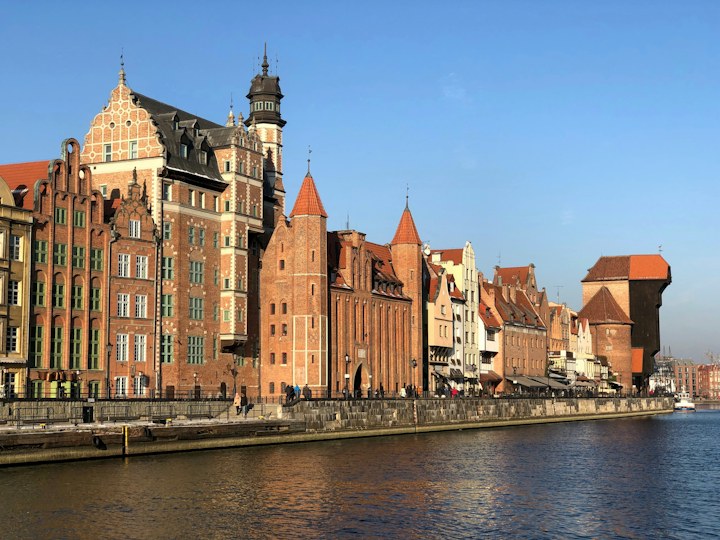
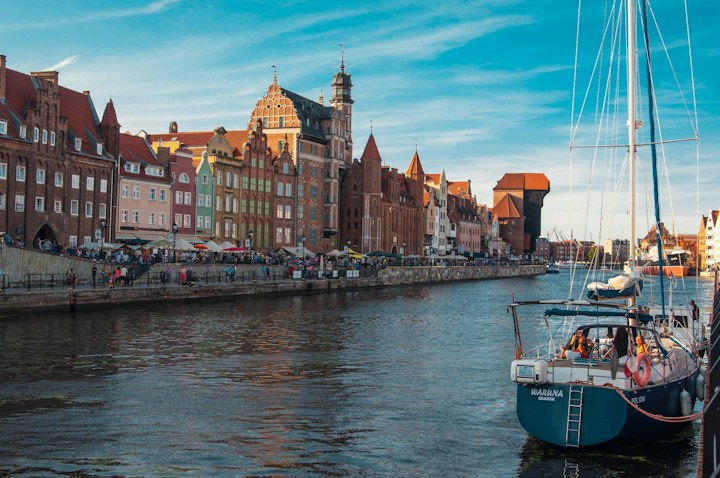
The waterfront in Gdańsk is easy to read as a single image: water, gables, brick and sky. In the morning, that image begins to separate into smaller events. A reflection breaks as a boat passes. Someone opens a door. Light reaches one façade while the next remains in shade. The familiar view becomes a sequence rather than a postcard.
Begin from a public place with enough room to stand without interrupting anyone. Look across the water before walking along it. From a distance, the roofline offers a rhythm of narrow and wide, high and low. Close up, the same buildings become surfaces and thresholds. Both views are useful, and moving between them gives the walk a natural structure.
“One street behind the view, another city is beginning its day.”
Step away from the water
After the first stretch, turn inland. The change can be immediate: less sky, a more enclosed sound and details that are too small to register from the river. Brick joints, ironwork and the proportions of doorways start to take the place of the skyline. There is no need to assign a historical story to every object in order to notice it carefully.
A quiet street is still a working street. Leave entrances clear, respect private courtyards and be patient around deliveries. The aim is to observe a city as it is being used, not to wait for it to become an empty set. People and practical routines are part of the view, even when they make a photograph less tidy.
Return with a different scale
Come back to the waterfront by another route. The broad scene is still there, but the smaller details now have somewhere to belong. A building you first noticed as a shape on the skyline may have become a doorway, a texture or a particular shade of stone. A short loop has made the picture more specific.
End with an ordinary pause rather than another checklist. Sit where it is permitted, put the camera away and let the route settle. The strongest memory may be a sound or a change of light rather than a landmark. That is enough material for a morning note, and a good reason not to hurry into the next plan.